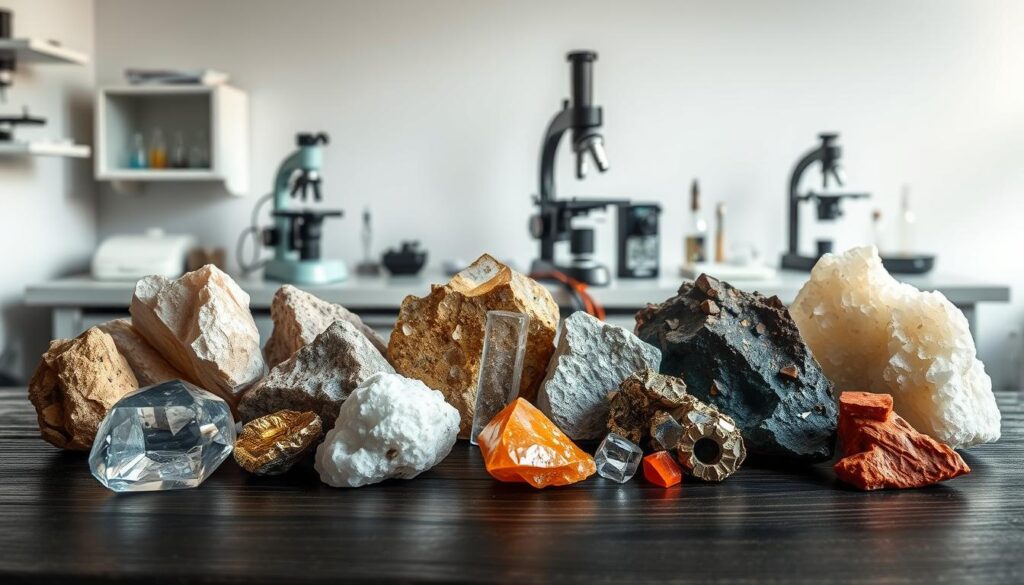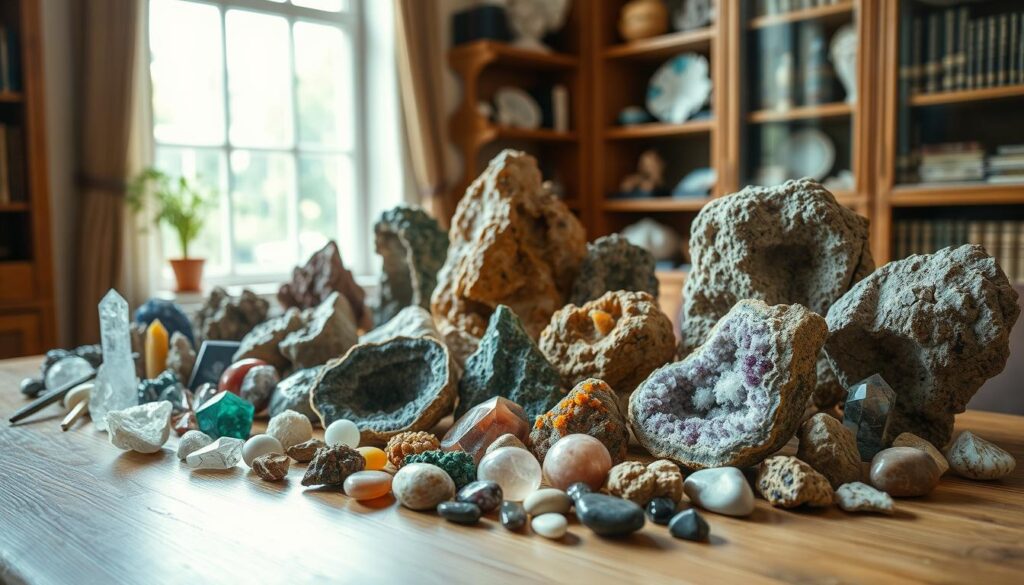
A Mineral Guide serves as your roadmap to understanding and identifying the countless mineral specimens found across our planet. Whether you’re stepping into the world of rockhounding for the first time or looking to expand your geological knowledge, having a solid foundation in mineral identification can transform your collecting adventures.
From the common quartz varieties you’ll encounter on most collecting trips to the rare specimens that make collectors’ hearts race, minerals tell the story of Earth’s incredible geological processes. Understanding their properties, formation methods, and identification techniques opens up a world of discovery that spans from your local creek bed to famous collecting locations worldwide.
TL;DR
- Over 5,000 known mineral species exist, but only about 200 are commonly found by collectors.
- The 7 crystal systems (cubic, tetragonal, orthorhombic, hexagonal, trigonal, monoclinic, triclinic) determine a mineral’s basic shape.
- Mohs hardness scale from 1-10 helps identify minerals using simple scratch tests with everyday items.
- Color, streak, luster, and cleavage provide the four main visual identification clues for any mineral specimen.
Understanding Mineral Guide Basics
Minerals are naturally occurring, inorganic substances with defined chemical compositions and crystal structures. Each mineral forms under specific conditions of temperature, pressure, and chemical environment, which explains why certain minerals appear together in the same locations.
The key to successful mineral identification lies in understanding systematic testing methods rather than relying on appearance alone. Many minerals look similar at first glance, but their physical properties reveal their true identity through simple field tests.
Essential Physical Properties
Every mineral exhibits specific physical properties that remain consistent regardless of specimen size or location. These properties form the foundation of mineral identification and include both observable characteristics and measurable qualities.
- Hardness – resistance to scratching, measured on the Mohs scale from 1-10.
- Color – the visible hue, though this can vary due to impurities.
- Streak – the color of the mineral’s powder when scratched on unglazed porcelain.
- Luster – how light reflects off the mineral’s surface (metallic, vitreous, dull, etc.).
- Cleavage – how the mineral breaks along flat, smooth planes.
- Fracture – how the mineral breaks when not following cleavage planes.
- Specific gravity – density compared to water.
Common Mineral Groups and Families
Minerals are classified into major groups based on their chemical composition. Understanding these groups helps narrow down identification possibilities and explains why certain minerals share similar properties or occur together in nature.
Silicate Minerals
Making up about 90% of Earth’s crust, silicate minerals contain silicon and oxygen as their primary components. This diverse group includes most of the gemstones found across the United States and forms the backbone of igneous and metamorphic rocks.
- Quartz Group – includes amethyst, citrine, smoky quartz, and rose quartz.
- Feldspar Group – orthoclase, plagioclase, and microcline varieties.
- Mica Group – muscovite and biotite with perfect cleavage.
- Garnet Group – almandine, pyrope, and grossular varieties.
- Pyroxene Group – augite and diopside in darker igneous rocks.
Carbonate Minerals
These minerals contain carbonate (CO₃) groups and often form in sedimentary environments or through hydrothermal processes. They typically react with weak acids, making them easy to identify in the field.
- Calcite – fizzes in weak acid, shows double refraction.
- Dolomite – fizzes only when powdered or in stronger acid.
- Malachite – bright green copper carbonate with distinctive patterns.
- Azurite – deep blue copper carbonate, often found with malachite.
Crystal Systems and Mineral Shapes
Every mineral belongs to one of seven crystal systems based on the geometric arrangement of its atoms. Understanding these crystal shapes helps with identification and explains why minerals develop their characteristic forms.
The Seven Crystal Systems
- Cubic (Isometric). Equal axes at right angles – like pyrite cubes or fluorite octahedrons.
- Tetragonal. Three axes at right angles, one longer – like zircon crystals.
- Orthorhombic. Three unequal axes at right angles – like topaz or barite.
- Hexagonal. Four axes, three equal in one plane – like quartz or beryl.
- Trigonal. Similar to hexagonal but with three-fold symmetry – like calcite or tourmaline.
- Monoclinic. Three unequal axes, two at right angles – like gypsum or orthoclase.
- Triclinic. Three unequal axes, none at right angles – like plagioclase feldspar.
Quick Crystal System Check
Look for symmetry patterns in well-formed crystals. Count the number of similar faces meeting at a point to help determine the crystal system.
Field Identification Techniques
Successful mineral identification in the field requires a systematic approach using simple tools and testing methods. Rather than guessing based on appearance alone, follow a logical sequence of tests to narrow down possibilities.
Basic Field Tests
These tests can be performed anywhere with minimal equipment and provide reliable identification data for most common minerals.
- Hardness Test – use fingernail (2.5), copper penny (3), steel nail (5.5), or glass (5.5-6).
- Streak Test – scratch the mineral on unglazed porcelain tile.
- Acid Test – place a drop of weak hydrochloric acid to test for carbonates.
- Magnet Test – check for magnetic minerals like magnetite or pyrrhotite.
- Luster Assessment – observe how light reflects off fresh surfaces.
- Cleavage Check – look for flat, smooth breaking surfaces.
Advanced Testing Methods
For challenging specimens or valuable finds, additional tests provide more definitive identification results.
- Specific Gravity – weigh specimens in air and water to calculate density.
- Fluorescence – use UV light to reveal fluorescent properties.
- Crystal Form Analysis – measure crystal angles with a contact goniometer.
- Optical Tests – use hand lenses to examine crystal faces and internal structures.
Common Minerals Every Collector Should Know
Certain minerals appear so frequently in collecting areas that recognizing them becomes essential for any serious rockhound. These species represent the building blocks of most rock formations and often provide clues to other minerals in the area.
The Big Ten Rock-Forming Minerals
These minerals make up the majority of igneous, sedimentary, and metamorphic rocks found worldwide.
- Quartz. Hardness 7, glassy luster, no cleavage – found in almost every geological environment.
- Feldspar. Hardness 6, two cleavages at right angles – most abundant mineral group in Earth’s crust.
- Mica. Perfect cleavage in thin sheets, metallic to pearly luster.
- Calcite. Hardness 3, fizzes in acid, shows double refraction.
- Dolomite. Similar to calcite but fizzes only when powdered.
- Gypsum. Hardness 2, can be scratched with fingernail.
- Halite. Cubic crystals, salty taste, dissolves in water.
- Pyrite. Brassy color, cubic crystals, produces sparks when struck.
- Magnetite. Black, metallic luster, strongly magnetic.
- Hematite. Red-brown streak, metallic to dull luster.
Regional Specialties
Different geological regions produce characteristic mineral assemblages based on their formation history. Learning about famous collecting locations helps understand which minerals to expect in different areas.
For example, the pegmatite districts of New England produce spectacular tourmaline, beryl, and feldspar specimens, while the limestone regions of the Midwest yield excellent calcite, fluorite, and galena crystals.
Building Your Reference Collection
A well-organized reference collection serves as your personal mineral identification library. Start with common species from your local area before expanding to include examples from other regions or mineral groups.
Essential Reference Specimens
These minerals provide standards for testing and comparison when identifying unknown specimens.
- Hardness Standards – talc (1), gypsum (2), calcite (3), fluorite (4), apatite (5), orthoclase (6), quartz (7), topaz (8), corundum (9).
- Color Varieties – examples showing how the same mineral can display different colors.
- Crystal Forms – well-formed crystals demonstrating each crystal system.
- Cleavage Examples – specimens showing perfect, good, and poor cleavage.
- Luster Types – minerals exhibiting metallic, vitreous, pearly, and dull lusters.
Focus on acquiring quality specimens that clearly show diagnostic features rather than accumulating large quantities of similar materials. A single excellent specimen teaches more than dozens of poor examples.
Documentation and Organization
Proper documentation transforms a random collection of rocks into a valuable scientific and educational resource. Each specimen should include location data, collection date, and identification information to maximize its long-term value.
Essential Record-Keeping
Maintain detailed records for each specimen to preserve important geological and collecting information.
- Specimen Number – unique identifier linking the physical specimen to your records.
- Location Data – specific collecting site with GPS coordinates when possible.
- Collection Date – when the specimen was found.
- Mineral Identification – species name and variety if applicable.
- Physical Properties – size, weight, and notable characteristics.
- Associated Minerals – other species found at the same location.
- Geological Context – rock type and formation information.
Frequently Asked Questions
How many minerals do I need to learn for basic identification?
Start with 20-30 common minerals that represent major mineral groups and crystal systems. This foundation covers 80% of specimens you’ll encounter while collecting.
What’s the difference between a rock and a mineral?
A mineral is a single, naturally occurring substance with a defined chemical formula, while a rock is composed of one or more minerals mixed together. Granite is a rock containing quartz, feldspar, and mica minerals.
Can the same mineral have different colors?
Yes, many minerals show color variations due to trace impurities or structural differences. Quartz appears as purple amethyst, yellow citrine, or colorless rock crystal depending on which trace elements are present.
Why is streak more reliable than color for identification?
Streak color remains consistent even when the mineral’s surface color varies due to weathering or impurities. Hematite always produces a red-brown streak regardless of whether the specimen appears metallic gray or rusty red.
How do I test hardness without damaging valuable specimens?
Test hardness on inconspicuous areas or broken edges rather than crystal faces. Use materials slightly softer and harder than your estimate to bracket the actual hardness without excessive scratching.
Final Thoughts
A comprehensive Mineral Guide provides the foundation for successful collecting and identification adventures. Master the basic testing methods and common species first, then gradually expand your knowledge as you encounter more specialized specimens in the field.
Remember that mineral identification combines science with detective work – each clue helps narrow the possibilities until you reach a confident identification. Start building your reference collection this week and begin documenting your finds properly from day one.