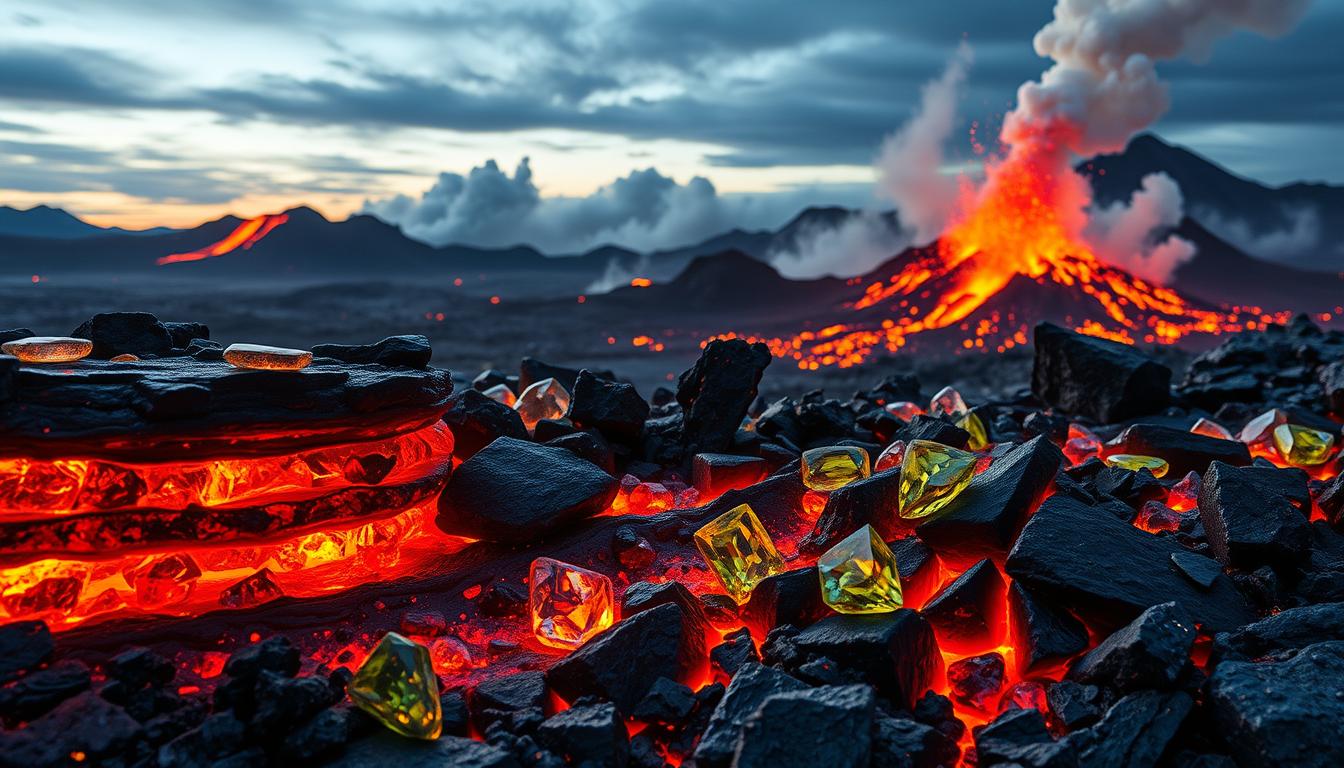
How Volcanic Areas Produce Gemstones is a fascinating geological process that transforms ordinary minerals into precious treasures through extreme heat, pressure, and unique chemical conditions. Volcanic regions create some of the world’s most valuable gems including diamonds, sapphires, and rare collector stones that can’t form anywhere else on Earth.
The intense temperatures and mineral-rich environments found in volcanic zones provide the perfect conditions for gemstone formation. Understanding this process helps explain why certain regions become famous for specific types of gems and why volcanic areas remain prime locations for both commercial mining and amateur rockhounding.
TL;DR
- Kimberlite pipes from ancient volcanoes bring diamonds from 150+ kilometers deep in the Earth’s mantle to the surface.
- Basaltic lava flows create cavities where agates, amethyst, and other quartz varieties crystallize over thousands of years.
- Metamorphic zones around volcanic intrusions reach temperatures of 400-800°C, forming sapphires, rubies, and garnets.
- Pegmatite dikes associated with volcanic activity produce tourmaline, topaz, and beryl crystals up to several feet long.
How Volcanic Areas Produce Gemstones
Volcanic gemstone formation occurs through three main geological processes that work together or separately depending on the specific volcanic environment. Each process creates different types of gems under unique conditions that can’t be replicated elsewhere in nature.
The key factor is that volcanic activity provides both the extreme conditions needed for gemstone formation and the transport mechanisms to bring deep-Earth minerals to accessible depths. This combination makes volcanic regions the most productive gemstone sources worldwide, which explains why certain areas produce more gems than others.
Primary Volcanic Gemstone Formation
Direct volcanic processes create gemstones through crystallization from molten rock and high-temperature mineral solutions. These primary formation methods produce some of the most valuable and sought-after gems in the world.
Kimberlite Pipe Formation
Kimberlite pipes are ancient volcanic conduits that explosively brought diamonds from the Earth’s mantle to near-surface depths millions of years ago. These pipe-shaped formations contain diamonds that formed under extreme pressure conditions 150-200 kilometers below the surface where carbon crystallized into diamond structure.
- Diamond formation depth – Occurs at 150-200 km deep where pressure exceeds 45,000 times atmospheric pressure
- Transport mechanism – Explosive volcanic eruptions carry diamond-bearing rock rapidly to the surface
- Preservation conditions – Rapid ascent prevents diamonds from converting back to graphite
- Age requirements – Most diamond-bearing kimberlites are over 1 billion years old
Pegmatite Dike Systems
Pegmatite dikes form when mineral-rich fluids from cooling volcanic intrusions create large crystal cavities in surrounding rocks. These systems produce some of the largest and most perfect gem crystals found in nature, including tourmaline, topaz, and beryl varieties like emerald and aquamarine.
- Initial intrusion. Volcanic magma intrudes into existing rock formations and begins cooling slowly.
- Fluid separation. Water-rich fluids carrying dissolved minerals separate from the cooling magma.
- Cavity formation. These fluids force their way into cracks and create large open spaces.
- Crystal growth. Slow cooling allows large, well-formed crystals to develop over thousands of years.
Secondary Volcanic Gemstone Processes
Secondary processes occur when volcanic heat and fluids alter existing rocks or when volcanic cavities provide spaces for later mineral crystallization. These processes often produce the colorful and varied gemstones that make volcanic regions famous among collectors.
Metamorphic Contact Zones
The area surrounding volcanic intrusions experiences intense heat that transforms existing minerals into new gem varieties without melting the original rock. This contact metamorphism creates some of the world’s finest sapphires, rubies, and garnets in distinct zones around volcanic bodies, similar to how metamorphic rocks produce crystals through heat and pressure.
Temperature zones around volcanic intrusions determine which gems form at different distances from the heat source. The closest zones reach 800°C and produce high-grade gems, while outer zones at 400-500°C create different but equally valuable varieties.
Best Rockhounding Locations
Focus on ancient volcanic areas rather than recently active ones for the safest and most productive gem hunting. Areas that were volcanic 10+ million years ago have had time for proper gem formation and cooling.
Vesicular Basalt Cavities
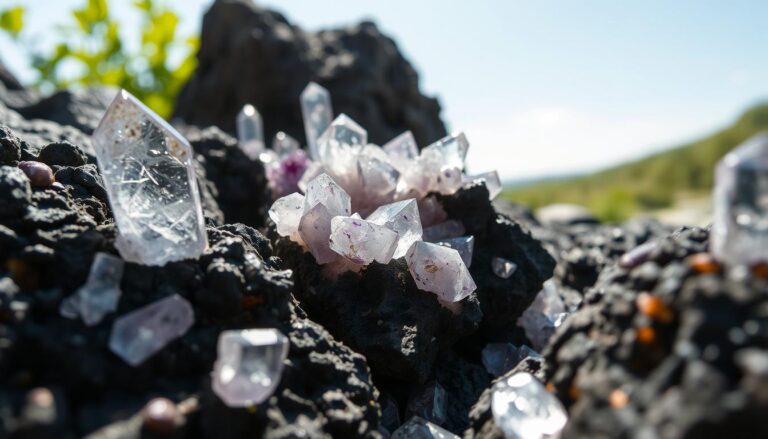
Gas bubbles trapped in cooling lava create hollow spaces called vesicles that later fill with mineral-rich groundwater. Over thousands of years, this process creates agate, amethyst, and other quartz family gems that form concentric bands or crystal clusters within the original bubble spaces.
- Vesicle formation – Gas bubbles become trapped as lava cools and solidifies
- Water infiltration – Groundwater carrying dissolved silica enters the hollow spaces
- Layer deposition – Silica precipitates in layers, creating agate banding patterns
- Crystal development – Final stages produce clear quartz points and amethyst clusters
Hydrothermal Gem Formation
Hydrothermal systems associated with volcanic activity create some of the most valuable and rare gemstones through hot water solutions that dissolve, transport, and deposit minerals in specific geological environments. These systems can remain active for millions of years, continuously producing new gem deposits where geological conditions affect gem quality through temperature, pressure, and chemical composition.
Hot Spring Systems
Volcanic hot springs create unique chemical environments where rare elements concentrate and crystallize into gems not found elsewhere. These systems produce fire opals, cinnabar, and various rare collector minerals that form only under specific temperature and chemical conditions.
The key to hydrothermal gem formation is the combination of heat, mineral-rich water, and the right chemical environment for crystallization. Different temperature ranges and mineral concentrations produce distinctly different types of gems within the same overall system.
Geographic Distribution of Volcanic Gems
Volcanic gemstone deposits follow predictable patterns based on the type of volcanic activity and geological age of different regions. Understanding these patterns helps explain why certain areas become world-famous for specific types of gems while others produce more common varieties, and how old geological events created today’s gem areas through ancient volcanic processes.
The most productive volcanic gem regions are typically found along ancient continental margins, island arc systems, and areas of past hotspot activity. These environments provided the right combination of volcanic processes, mineral availability, and geological stability needed for major gem formation.
- Shield volcano regions – Produce basalt-hosted agates and zeolite minerals
- Stratovolcano areas – Generate contact metamorphic sapphires and garnets
- Caldera systems – Create obsidian, perlite, and volcanic glass gems
- Kimberlite fields – Contain the world’s primary diamond deposits
Frequently Asked Questions
Do active volcanoes produce gemstones?
Active volcanoes can form some gems like obsidian and volcanic glass immediately, but most valuable gemstones require thousands to millions of years of cooling and crystallization. The best gem hunting occurs in areas of ancient volcanic activity.
Why are diamonds only found in certain volcanic rocks?
Diamonds form under extreme pressure conditions only found 150+ kilometers deep in the Earth’s mantle. Only kimberlite and lamproite volcanic eruptions are powerful enough to bring diamonds from these depths to the surface without destroying them.
What gems form in volcanic gas bubbles?
Agates, amethyst, and other quartz varieties commonly form in volcanic vesicles (gas bubbles). These gems develop when mineral-rich groundwater slowly fills the hollow spaces and crystallizes over thousands of years.
How long does volcanic gem formation take?
Formation times vary widely from immediate (obsidian) to millions of years (diamonds). Most common volcanic gems like agates and garnets require 10,000 to 100,000 years for complete formation.
Final Thoughts
How Volcanic Areas Produce Gemstones represents one of nature’s most spectacular geological processes, combining extreme conditions with precise mineral chemistry to create treasures that have fascinated humans for thousands of years. The variety of gems produced through different volcanic processes explains why these regions remain the world’s primary sources for both common and rare gemstones.
Whether you’re interested in the science behind gem formation or planning your next rockhounding adventure, understanding these volcanic processes helps explain why certain locations produce specific types of gems and what conditions create the most valuable specimens. For collectors looking to identify the rocks that commonly contain crystals, volcanic areas offer some of the best opportunities to find these natural treasures. For detailed geological information and current research on volcanic processes, the U.S. Geological Survey’s Hawaiian Volcano Observatory provides comprehensive data on active volcanic systems and their geological impacts.