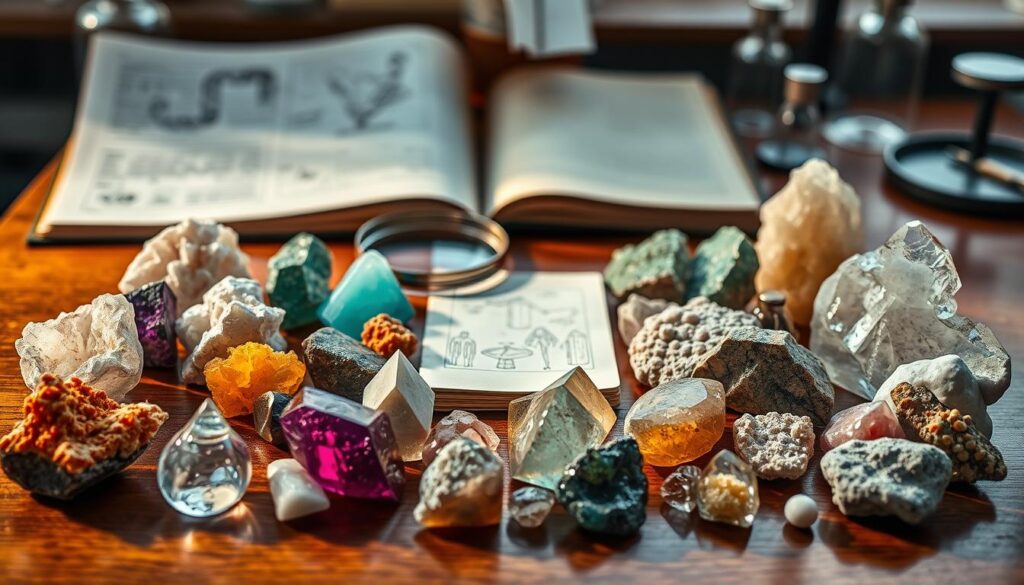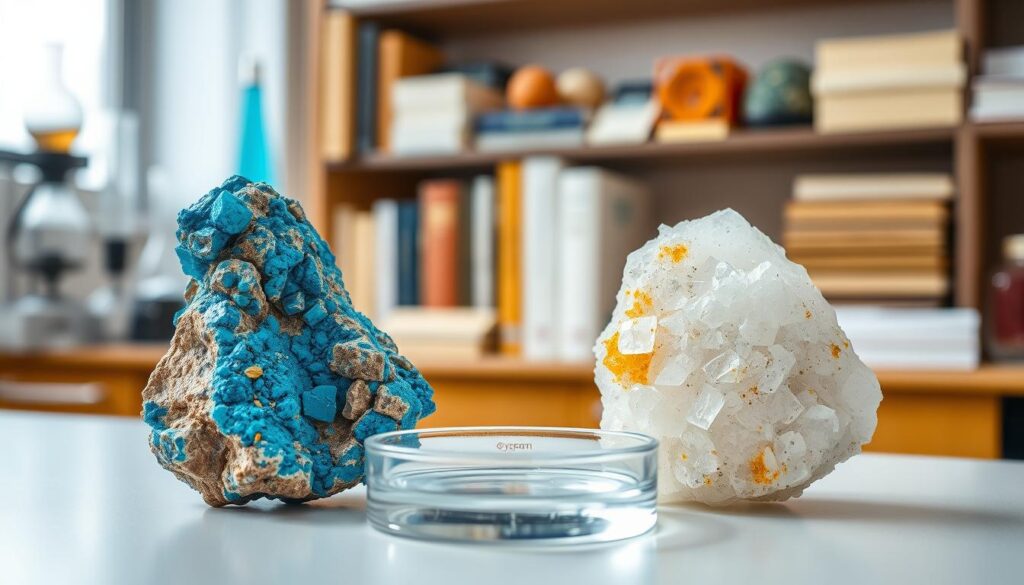
How To Tell Similar Minerals Apart can be challenging even for experienced collectors, but with the right techniques, you can confidently identify what you’ve found. Many minerals share similar colors, crystal shapes, or surface textures, making accurate identification seem nearly impossible at first glance.
The key lies in understanding that minerals have unique physical and chemical properties that serve as their fingerprints. By learning to test these properties systematically, you’ll develop the skills to distinguish between even the most similar-looking specimens.
TL;DR
- Hardness testing using the Mohs scale (1-10) is the most reliable way to separate similar minerals – quartz scratches glass at 7 while calcite can’t at 3.
- Streak color often differs dramatically from surface color – hematite appears black but leaves a red-brown streak on ceramic.
- Crystal habits and cleavage patterns are unique identifiers – mica splits into thin sheets while feldspar breaks along two planes at 90 degrees.
- Simple acid tests with white vinegar can instantly separate carbonates like calcite (fizzes) from silicates like quartz (no reaction).
How To Tell Similar Minerals Apart
The foundation of mineral identification rests on understanding that each mineral species has a unique combination of physical properties. These properties remain consistent regardless of where the mineral formed or what it looks like on the surface.
Start with the most reliable tests first – hardness, streak, and crystal form – before moving to more advanced techniques. This systematic approach prevents misidentification and builds your confidence as you practice with field identification methods.
Essential Physical Property Tests
Physical properties provide the most accessible and reliable methods for mineral identification. These tests require minimal equipment and can be performed safely in the field or at home.
Hardness Testing
The Mohs hardness scale ranks minerals from 1 (talc) to 10 (diamond) based on their ability to scratch other materials. This test works because hardness reflects the strength of chemical bonds within the mineral’s crystal structure.
- Fingernail (2.5) – Scratches gypsum and talc but not calcite
- Copper penny (3.5) – Scratches calcite but not fluorite
- Steel nail (5.5) – Scratches apatite but not orthoclase
- Glass plate (5.5-6) – Scratched by quartz but not by feldspar
- Steel file (6.5) – Scratches orthoclase but not quartz
Streak Testing
Streak refers to the color of a mineral’s powder when scraped across an unglazed ceramic tile. This property remains constant even when the mineral’s surface appears different due to weathering or impurities.
Many metallic minerals show dramatic differences between surface color and streak color. Pyrite appears golden but produces a greenish-black streak, while chalcopyrite creates a greenish-black streak despite its brassy appearance.
Crystal Structure and Cleavage Analysis
Crystal habits describe how minerals naturally grow and form their external shapes. Even when crystals appear broken or weathered, you can often identify characteristic features that point to specific mineral families.
Common Crystal Systems
- Cubic – Pyrite forms perfect cubes with striated faces
- Hexagonal – Quartz develops six-sided prisms with pyramid terminations
- Orthorhombic – Sulfur creates elongated crystals with unequal axes
- Monoclinic – Gypsum forms tabular or blade-like crystals
Cleavage Patterns
Cleavage describes how minerals break along planes of weakness in their crystal structure. This property provides one of the most diagnostic features for identification, especially when dealing with different hardness levels in your collection.
- Perfect cleavage – Mica splits into paper-thin sheets
- Good cleavage – Feldspar breaks along two planes at nearly 90 degrees
- Poor cleavage – Pyroxene shows faint cleavage lines
- No cleavage – Quartz fractures irregularly like broken glass
Pro Testing Tip
Always perform hardness tests on fresh, unweathered surfaces for accurate results. Weathered surfaces can give false readings that lead to misidentification.
Chemical Testing Methods
Simple chemical tests can quickly separate minerals that appear identical but belong to different chemical families. These tests work because different mineral groups react differently to common acids and other reagents.
Acid Testing
The most useful chemical test involves dropping dilute hydrochloric acid or white vinegar on a mineral sample. Carbonate minerals like calcite, dolomite, and malachite will fizz vigorously, while silicate minerals show no reaction.
This test instantly separates limestone from quartzite, or distinguishes between calcite and quartz crystals. Always perform acid tests in well-ventilated areas and wear safety glasses.
Flame Testing
Some minerals produce characteristic flame colors when heated, though this requires more advanced equipment and safety precautions. Copper-bearing minerals create green flames, while sodium-rich minerals burn yellow-orange.
Advanced Identification Techniques
When basic tests don’t provide clear answers, additional techniques can help resolve difficult identifications. These methods require more specialized knowledge but offer greater precision, which is especially important when avoiding common identification mistakes.
Specific Gravity Testing
Specific gravity measures how dense a mineral feels compared to water. Heavy minerals like galena (specific gravity 7.5) feel noticeably heavier than light minerals like quartz (specific gravity 2.65) of the same size.
You can estimate specific gravity by hefting similar-sized samples, though precise measurements require a balance and water displacement setup. This test proves especially useful when dealing with commonly found minerals during rockhounding that might appear similar.
Optical Properties
Luster describes how light reflects off a mineral’s surface, providing another diagnostic feature. Common luster types include metallic, vitreous (glassy), pearly, silky, and earthy.
- Metallic luster – Pyrite, galena, and hematite
- Vitreous luster – Quartz, feldspar, and garnet
- Pearly luster – Talc, gypsum, and mica
- Silky luster – Fibrous minerals like asbestos
Distinguishing Common Look-Alikes
Certain mineral pairs cause confusion for both beginners and experienced collectors. Understanding the key differences between these similar minerals prevents costly identification mistakes.
Quartz vs. Calcite
These two common minerals often appear in similar environments and crystal forms. Quartz rates 7 on the Mohs scale and won’t react to acid, while calcite measures 3 on the hardness scale and fizzes vigorously in vinegar.
Calcite also shows perfect rhombohedral cleavage, breaking into angled fragments, while quartz fractures irregularly without flat surfaces.
Pyrite vs. Chalcopyrite vs. Gold
All three minerals appear golden, but simple tests reveal their true identities. Real gold remains soft and malleable, while pyrite and chalcopyrite feel hard and brittle.
- Gold – Soft (2.5-3), no tarnish, very heavy
- Pyrite – Hard (6.5), cubic crystals, greenish-black streak
- Chalcopyrite – Medium hard (3.5-4), tarnishes to rainbow colors
Frequently Asked Questions
What’s the most reliable single test for identifying minerals?
Hardness testing provides the most reliable single diagnostic test because it reflects the mineral’s internal crystal structure and remains consistent across all specimens of the same species.
Can I identify minerals without breaking them?
Yes, you can use non-destructive tests like hardness testing with common objects, observing crystal habits, checking luster, and performing streak tests on inconspicuous areas.
Why do some minerals look different but test the same?
Trace impurities, crystal defects, and surface weathering can change a mineral’s appearance while leaving its fundamental physical properties unchanged, which is why testing multiple properties ensures accurate identification.
How accurate are smartphone mineral identification apps?
Smartphone apps provide useful starting points but can’t replace hands-on testing since they rely only on visual appearance, which can be misleading for many similar-looking minerals.
Final Thoughts
How To Tell Similar Minerals Apart becomes much easier once you master the fundamental testing techniques and understand that each mineral has a unique combination of physical properties. The key lies in testing multiple properties systematically rather than relying on appearance alone.
Start practicing with common minerals you can easily obtain, and gradually work up to more challenging identifications as your skills develop. With patience and practice, you’ll soon distinguish between even the most similar-looking specimens with confidence.