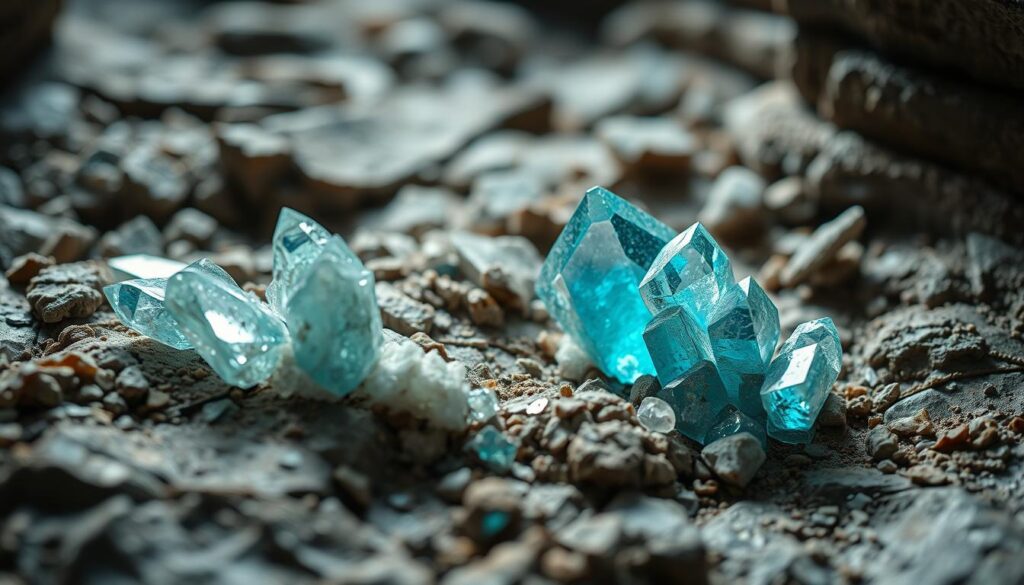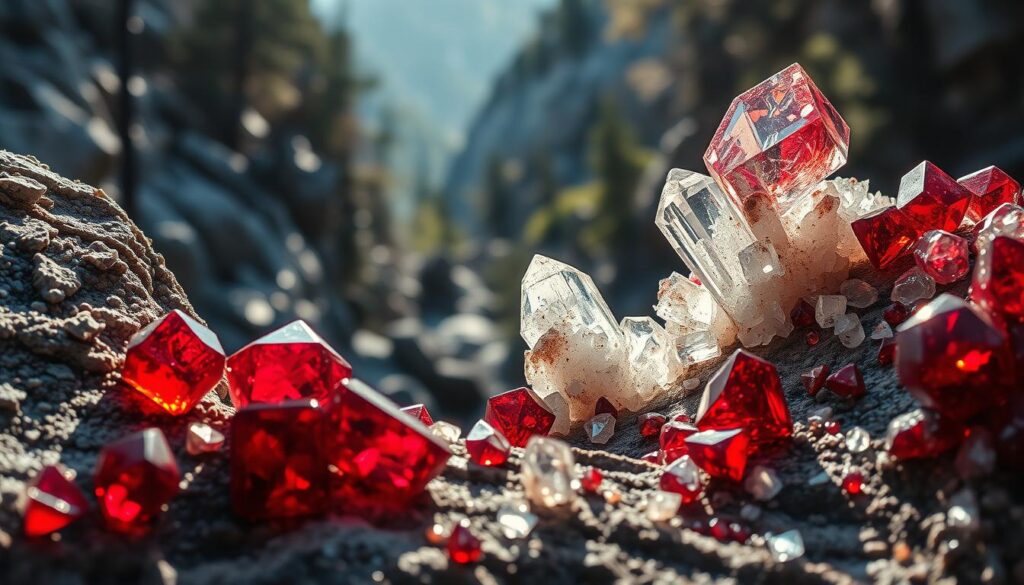
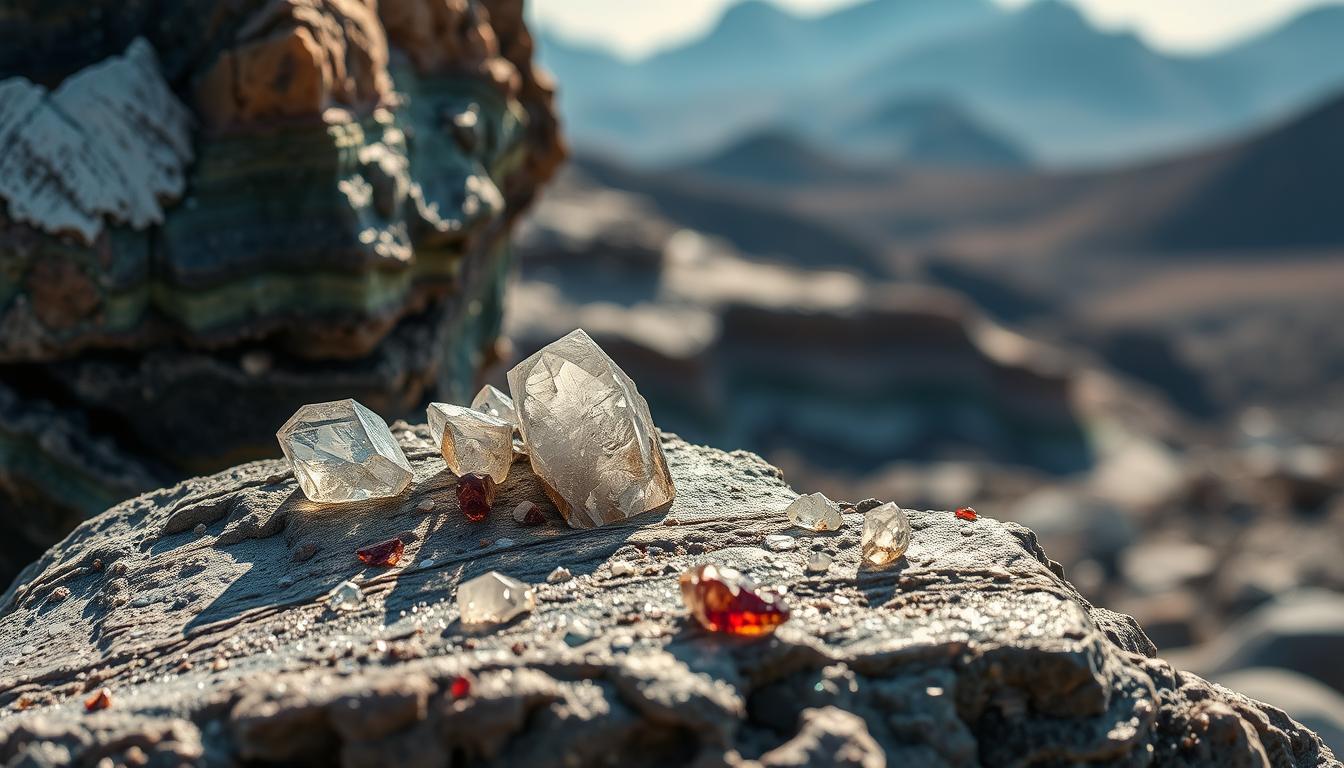
How Metamorphic Rocks Produce Crystals is a fascinating process that transforms ordinary minerals into stunning crystal formations deep within the Earth. When existing rocks face intense heat and pressure over thousands of years, their mineral structure changes completely, often creating beautiful crystals that eventually make their way to the surface.
This natural process happens far below our feet, where temperatures can reach over 1,000 degrees Fahrenheit and pressure builds to incredible levels. The combination of these extreme conditions forces atoms to rearrange themselves into new crystal patterns, creating gems and minerals that have captivated humans for centuries.
TL;DR
- Metamorphic crystals form at temperatures between 400-1,200°F and pressures 1,000 times greater than surface conditions.
- The process takes between 10,000 to 1 million years depending on the depth and intensity of heat and pressure.
- Common metamorphic crystals include garnet, staurolite, andalusite, and sillimanite that form at specific temperature ranges.
- Regional metamorphism affects large areas during mountain building, while contact metamorphism occurs around hot magma bodies.
How Metamorphic Rocks Produce Crystals
Metamorphic crystal formation begins when existing rocks get buried deep enough to experience significant heat and pressure changes. The parent rock, called a protolith, can be igneous, sedimentary, or even another metamorphic rock that undergoes further transformation.
As conditions intensify, the original minerals become unstable and begin to recrystallize into new forms. This process happens in the solid state – the rock never actually melts, but atoms migrate and reorganize to create entirely new crystal structures that are stable under the new conditions.
Types of Metamorphic Crystal Formation
Two main types of metamorphism create different crystal formation environments. Each type produces distinct mineral assemblages based on the specific conditions involved.
Regional Metamorphism
Regional metamorphism affects large areas during mountain-building events when tectonic plates collide. The process creates extensive zones of crystal formation that can span hundreds of miles.
- Low-grade metamorphism – produces chlorite, muscovite, and biotite crystals at 400-500°F.
- Medium-grade metamorphism – forms garnet, staurolite, and kyanite crystals at 500-700°F.
- High-grade metamorphism – creates sillimanite and orthoclase crystals above 700°F.
Contact Metamorphism
Contact metamorphism occurs when hot magma intrudes into cooler surrounding rocks. The heat from the magma body creates a zone of crystal formation called an aureole.
- Andalusite – forms in aluminum-rich rocks near the contact zone.
- Cordierite – develops in magnesium and iron-bearing rocks.
- Wollastonite – appears when limestone encounters hot granite intrusions.
Key Factors in Crystal Development
Several critical factors determine which crystals form during metamorphism. Understanding these conditions helps explain why certain areas produce more gems and which minerals appear in specific rock types and locations.
Temperature Control
Temperature acts as the primary driver of chemical reactions during metamorphism. Different minerals have specific temperature ranges where they remain stable and form crystals.
- Low temperature (400-500°F). Creates fine-grained crystals like chlorite and muscovite that give rocks a shiny appearance.
- Moderate temperature (500-700°F). Produces larger, well-formed crystals such as garnet and staurolite that are easily visible.
- High temperature (700°F+). Forms coarse crystals like sillimanite and creates migmatites with partial melting.
Pressure Effects
Pressure influences both the types of crystals that form and their orientation within the rock. Directed pressure creates foliation, while uniform pressure affects mineral stability.
- Confining pressure – affects which mineral phases are stable at given temperatures.
- Directed pressure – causes crystals to align and creates foliated textures like schist and gneiss.
- Fluid pressure – helps transport ions and accelerates crystal growth rates.
Crystal Size Indicator
Larger crystals typically indicate slower cooling and longer formation times. Fine-grained metamorphic rocks suggest rapid temperature changes or shorter metamorphic events.
Common Metamorphic Crystals
Specific crystals form predictably under certain metamorphic conditions. Geologists use these index minerals to determine the temperature and pressure conditions that existed during rock formation, which is crucial knowledge for rock types collectors commonly find in the field.
Index Minerals
Index minerals indicate specific metamorphic grades and help map the intensity of metamorphic events across regions. Each mineral has a narrow stability range that makes it useful for temperature estimation.
- Chlorite – green flaky crystals that form at low temperatures around 400°F.
- Biotite – dark mica crystals that appear at slightly higher temperatures near 450°F.
- Garnet – red to pink dodecahedral crystals stable at medium-grade conditions around 550°F.
- Staurolite – brown cross-shaped crystals that form at temperatures near 600°F.
- Sillimanite – needle-like crystals that only form at high temperatures above 700°F.
Accessory Minerals
Many other crystals form during metamorphism depending on the original rock composition. These minerals add complexity and beauty to metamorphic rocks, and understanding which rocks commonly contain crystals helps collectors identify promising specimens.
- Andalusite – rectangular crystals with dark cross patterns visible in thin sections.
- Kyanite – blue blade-like crystals that form under high pressure conditions.
- Cordierite – violet crystals that develop in magnesium-rich rocks.
- Epidote – green crystals common in metamorphosed basalts and gabbros.
Crystal Growth Mechanisms
Crystals grow through several different processes during metamorphism. The specific mechanism depends on temperature, pressure, and the presence of fluids that help transport material.
Solid-State Diffusion
At high temperatures, atoms can migrate through solid crystals to reach growing crystal faces. This process happens slowly but allows for complete recrystallization without melting.
Solid-state diffusion explains how large crystals like garnet can form by consuming smaller grains of other minerals. The process requires significant time, often hundreds of thousands of years for centimeter-sized crystals.
Fluid-Assisted Growth
Hot fluids accelerate crystal formation by dissolving minerals in one location and depositing them elsewhere. These fluids often originate from dehydration reactions in clay minerals and micas.
Fluid-assisted growth creates some of the most spectacular metamorphic crystals, including large garnets and perfect staurolite crosses. The fluids act as a transport medium, allowing atoms to move much faster than through solid-state diffusion alone.
Frequently Asked Questions
How long does it take for metamorphic crystals to form?
Metamorphic crystals typically take 10,000 to 1 million years to form, depending on temperature, pressure, and crystal size. Larger crystals require more time to grow than smaller ones.
What temperature do metamorphic crystals need to form?
Most metamorphic crystals form at temperatures between 400°F and 1,200°F. Different minerals have specific temperature ranges where they remain stable and can crystallize.
Can metamorphic rocks form crystals without melting?
Yes, metamorphic crystals form entirely in the solid state without melting. Atoms reorganize and migrate to create new crystal structures while the rock remains solid throughout the process.
What makes some metamorphic crystals larger than others?
Crystal size depends on formation time, temperature, and fluid availability. Longer metamorphic events with higher temperatures and abundant fluids produce larger, well-formed crystals.
Final Thoughts
How Metamorphic Rocks Produce Crystals showcases one of nature’s most remarkable transformation processes. The combination of heat, pressure, and time creates stunning mineral specimens that reveal the dynamic forces operating deep within our planet.
Understanding this process helps us appreciate both the beauty of metamorphic crystals and the incredible geological forces that shape our Earth’s crust over millions of years. For collectors seeking to understand these formations better, geology basics every rock collector should know provides essential background knowledge, while how geological conditions affect gem quality explains the relationship between formation environment and crystal characteristics. For detailed mineral identification and geological research, the USGS Florence Bascom Geoscience Center provides extensive resources on metamorphic petrology and crystal formation studies.