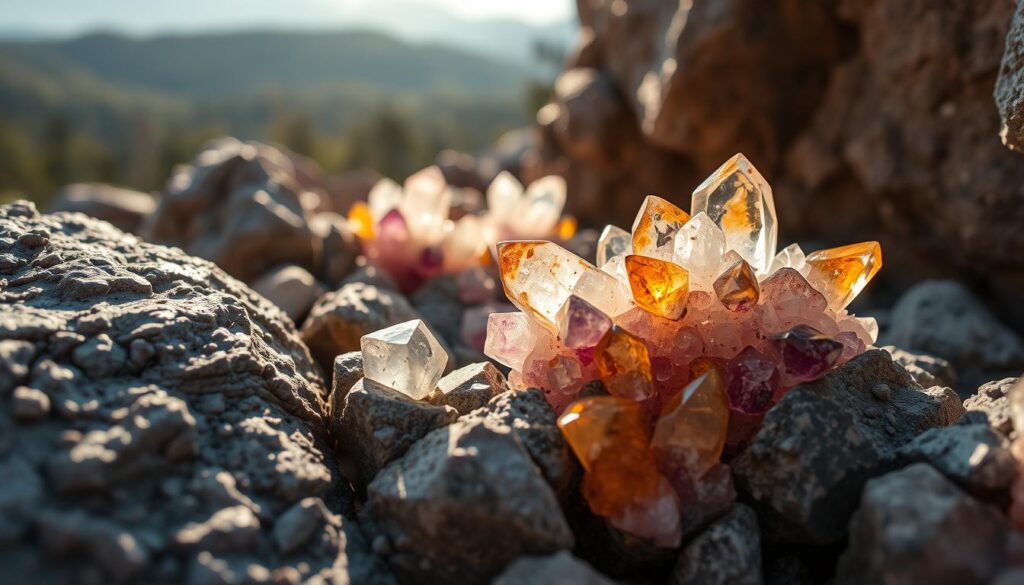
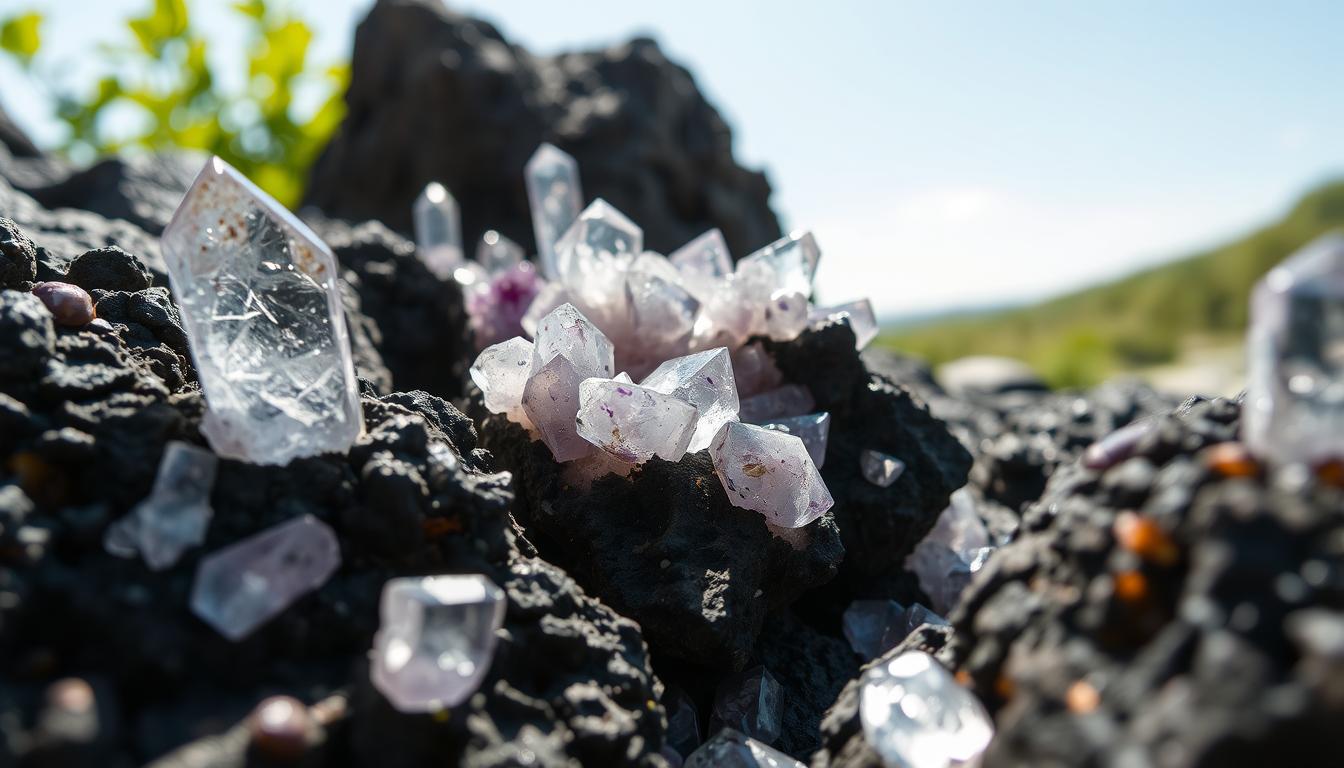
Rocks That Commonly Contain Crystals form naturally through various geological processes, creating stunning mineral formations that captivate collectors and geology enthusiasts worldwide. Understanding which rock types typically house these crystalline treasures can help you identify promising locations for crystal hunting and rock collecting adventures.
Whether you’re exploring volcanic regions, sedimentary formations, or metamorphic zones, certain rock types consistently yield beautiful crystal specimens. Learning to recognize these host rocks will dramatically improve your success rate when searching for natural crystals in the field.
TL;DR
- Granite pegmatites contain over 300 different mineral species including quartz, feldspar, and rare gems like tourmaline.
- Basalt flows create amygdaloid structures that host agates, zeolites, and calcite crystals in gas bubble cavities.
- Limestone caves and formations produce calcite, aragonite, and fluorite crystals through chemical precipitation processes.
- Geodes form in sedimentary rocks and volcanic ash, with 90% containing quartz or chalcedony crystal linings.
Rocks That Commonly Contain Crystals
Several rock types serve as natural hosts for crystal formation, each creating unique conditions that favor specific mineral growth. Igneous, sedimentary, and metamorphic rocks all contribute to crystal formation through different geological processes.
The most productive crystal-bearing rocks share common characteristics like cavities, fractures, or chemical compositions that allow minerals to precipitate and grow over time. These geological environments provide the space, time, and chemical conditions necessary for crystal development.
Igneous Rock Crystal Hosts
Igneous rocks form from cooled magma or lava and often contain some of the most spectacular crystal specimens. The cooling process and gas bubble formation create ideal conditions for mineral crystallization.
Granite and Pegmatites
Granite pegmatites represent the ultimate crystal treasure troves in the geological world. These coarse-grained igneous rocks form when mineral-rich fluids cool slowly deep underground, allowing large crystals to develop over thousands of years.
- Quartz varieties – smoky quartz, rose quartz, and clear quartz crystals up to several feet long.
- Feldspar crystals – orthoclase and plagioclase specimens with perfect crystal faces.
- Mica sheets – muscovite and biotite in large, flat crystal formations.
- Rare minerals – tourmaline, beryl, topaz, and garnet in gem-quality specimens.
Basalt and Volcanic Rocks
Basaltic lava flows create amygdaloid structures when gas bubbles become trapped during cooling. These cavities later fill with mineral-rich groundwater, producing beautiful crystal-lined pockets called amygdules. Understanding how volcanic areas produce gemstones can help collectors identify the most promising locations.
- Agate formations – banded chalcedony filling vesicles in basalt flows.
- Zeolite crystals – stilbite, heulandite, and chabazite in delicate crystal clusters.
- Calcite specimens – clear to white crystals with perfect rhombohedral shapes.
- Prehnite and epidote – green crystalline masses in altered basalt zones.
Sedimentary Rock Crystal Sources
Sedimentary rocks form through the accumulation and compression of sediments, but they also create environments where crystals can grow through chemical processes. Limestone formations and sandstone layers frequently host impressive crystal displays.
Limestone and Dolostone
Carbonate rocks like limestone provide ideal conditions for crystal growth through chemical precipitation and replacement processes. Cave systems in limestone create spectacular crystal formations over geological time periods.
- Cave formations. Limestone caves host stalactites, stalagmites, and flowstone featuring calcite crystals.
- Replacement crystals. Dolomite and calcite replace original limestone through metamorphic processes.
- Fluorite deposits. Purple, green, and clear fluorite crystals form in limestone fractures and cavities.
- Celestite occurrences. Blue celestite crystals develop in limestone beds and cave systems.
Safety First When Crystal Hunting
Always wear safety glasses and gloves when breaking rocks or exploring crystal sites. Many crystal-bearing rocks require hammers and chisels to access the specimens safely.
Sandstone and Conglomerates
Sandstone layers often contain geodes and crystal-filled concretions that formed during the rock’s burial and diagenesis. These sedimentary structures can yield surprising crystal discoveries, particularly in areas where riverbeds expose these formations.
- Quartz geodes – hollow spherical rocks lined with amethyst, citrine, or clear quartz points.
- Marcasite nodules – iron sulfide crystals in concretions within shale and sandstone layers.
- Barite roses – desert rose formations in sandstone beds of arid regions.
- Gypsum crystals – selenite and alabaster specimens in evaporite sequences.
Metamorphic Rock Crystal Environments
Metamorphic rocks form when existing rocks undergo heat and pressure changes, often creating new minerals and crystal formations. These rocks frequently contain crystals that developed during the metamorphic transformation process, and learning how metamorphic rocks produce crystals can significantly improve your collecting success.
Schist and Gneiss
High-grade metamorphic rocks like schist and gneiss commonly contain large, well-formed crystals that grew during regional metamorphism. The heat and pressure conditions favor the development of specific mineral assemblages.
- Garnet porphyroblasts – red almandine and pyrope crystals embedded in schist matrices.
- Staurolite crosses – twinned crystals forming natural cross shapes in metamorphic rocks.
- Kyanite blades – blue crystalline masses in high-pressure metamorphic zones.
- Andalusite crystals – chiastolite varieties with distinctive cross patterns.
Marble and Skarn Deposits
Contact metamorphic zones where igneous intrusions meet carbonate rocks create skarn deposits rich in unusual crystals. These environments produce some of the most diverse mineral assemblages found in nature.
- Diopside formation. Green pyroxene crystals develop in marble contact zones.
- Vesuvianite occurrence. Complex silicate crystals form in calcium-rich skarn environments.
- Grossular garnet. Green and brown garnet varieties crystallize in metamorphic limestone.
- Wollastonite needles. White fibrous crystals develop in high-temperature marble zones.
Frequently Asked Questions
What type of rock contains the most crystals?
Granite pegmatites contain the highest diversity of crystal species, with over 300 different minerals documented in these rocks. They form from mineral-rich fluids that cool slowly underground.
Can sedimentary rocks contain large crystals?
Yes, sedimentary rocks can host large crystals in geodes, caves, and replacement deposits. Limestone caves often contain massive calcite and aragonite crystal formations.
How do crystals form inside volcanic rocks?
Crystals form in volcanic rocks when gas bubbles create cavities that later fill with mineral-rich groundwater. The slow cooling and chemical precipitation process allows crystals to grow over time.
What tools do I need to extract crystals from rocks?
Basic crystal extraction requires safety glasses, gloves, a geological hammer, flat chisels, and a small pry bar. Always prioritize safety when breaking rocks to access crystal specimens.
Final Thoughts
Rocks That Commonly Contain Crystals offer endless opportunities for discovery and collection across diverse geological environments. From granite pegmatites to limestone caves, each rock type creates unique conditions that favor specific crystal growth patterns.
Start your crystal hunting adventures by learning to identify these host rocks in your local area, and always remember to follow collecting ethics and landowner permissions when exploring potential sites. Using geology maps for rockhounding can help you locate the most productive crystal-bearing formations. For detailed information about mineral identification and geological processes, consult resources from the U.S. Geological Survey to enhance your understanding of crystal formation environments.