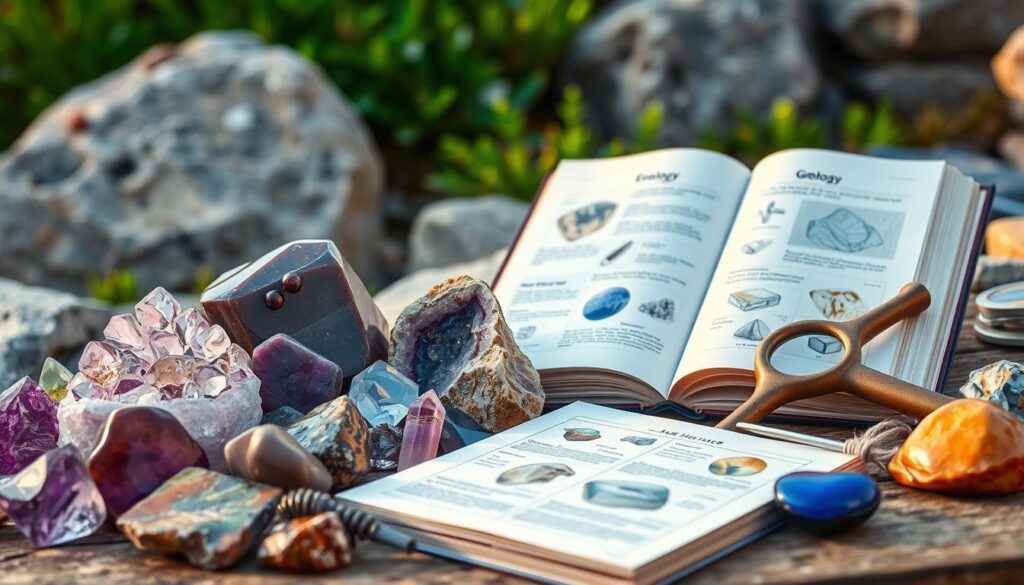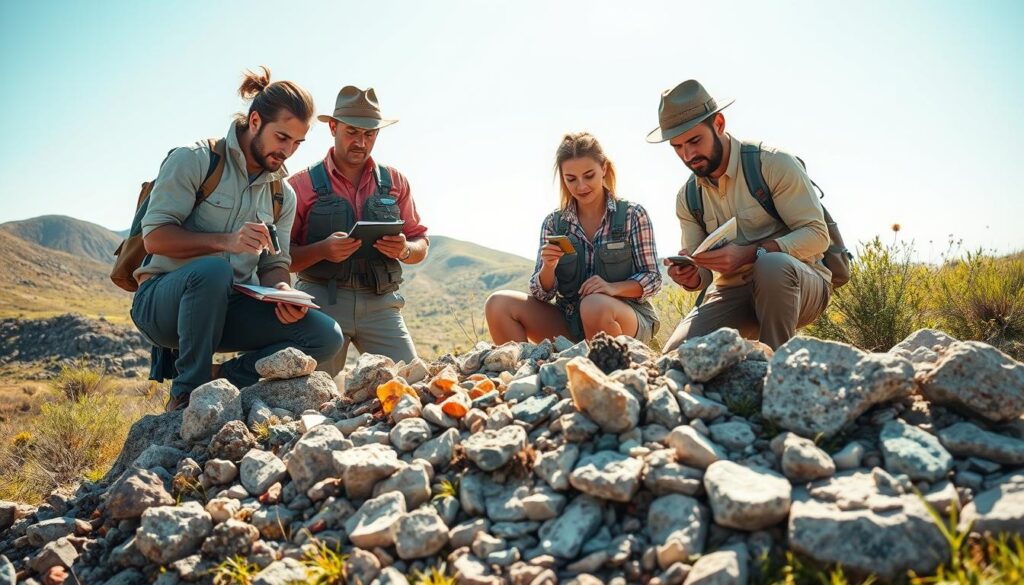
Geology Basics Every Rock Collector Should Know form the foundation for anyone passionate about collecting minerals, fossils, and geological specimens. Understanding these fundamental principles will help you identify rocks more accurately, appreciate their formation stories, and build a more meaningful collection.
Whether you’re just starting out or looking to deepen your knowledge, mastering these geological concepts will transform how you view the natural world around you. The science behind rock formation, mineral identification, and geological processes makes collecting far more rewarding than simply gathering pretty stones.
TL;DR
- The 3 main rock types are igneous (formed from cooled magma), sedimentary (formed from compressed layers), and metamorphic (changed by heat and pressure).
- The Mohs hardness scale rates minerals from 1-10, with talc being softest and diamond being hardest for field identification.
- Streak testing involves scratching a mineral on unglazed ceramic to reveal its true color, which often differs from surface appearance.
- Geological time spans 4.6 billion years, with most collectible fossils coming from the last 540 million years of the Phanerozoic Eon.
Geology Basics Every Rock Collector Should Know
The rock cycle forms the backbone of geological understanding and explains how all rocks transform from one type to another over millions of years. This continuous process shows that no rock type is permanent – granite can become gneiss, limestone can become marble, and sandstone can become quartzite through various geological forces.
Learning the rock cycle helps collectors understand why certain minerals appear together and why some rocks are more common in specific regions. For example, metamorphic rocks like garnet schist typically form in mountain-building regions where intense pressure and heat alter existing rocks.
The Three Rock Types
Every rock on Earth falls into one of three categories based on how it formed. Understanding these categories is essential for proper identification and helps you predict what minerals you might find in different locations.
Igneous Rocks
Igneous rocks form when molten rock (magma or lava) cools and solidifies. These rocks split into two main groups based on where they cooled.
- Intrusive igneous rocks – cooled slowly underground, creating large crystals you can see easily (granite, diorite, gabbro).
- Extrusive igneous rocks – cooled quickly on the surface, creating small crystals or glassy textures (basalt, rhyolite, obsidian).
Sedimentary Rocks
Sedimentary rocks form from compressed and cemented layers of sediment, organic material, or chemical deposits. These rocks often contain fossils and show distinct layering patterns.
- Clastic sedimentary – made from rock fragments (sandstone, shale, conglomerate).
- Chemical sedimentary – formed from mineral precipitation (limestone, rock salt, gypsum).
- Organic sedimentary – formed from plant or animal remains (coal, some limestones).
Metamorphic Rocks
Metamorphic rocks form when existing rocks change due to heat, pressure, or chemical activity without melting completely. The original rock type influences what the metamorphic rock becomes.
- Foliated metamorphic – show layered or banded appearance (slate, schist, gneiss).
- Non-foliated metamorphic – lack distinct layering (marble, quartzite, hornfels).
Mineral Identification Techniques
Proper mineral identification requires systematic testing of physical properties rather than relying solely on appearance. Many minerals look similar but have distinctly different properties that reveal their true identity.
Hardness Testing
The Mohs hardness scale ranks minerals from 1 to 10 based on what can scratch what. Every rock collector should memorize the ten reference minerals and carry simple testing tools.
- Talc (1) – softest, easily scratched by fingernail.
- Gypsum (2) – scratched by fingernail with pressure.
- Calcite (3) – scratched by copper penny.
- Fluorite (4) – scratched by steel knife easily.
- Apatite (5) – scratched by steel knife with pressure.
- Orthoclase (6) – scratches glass barely.
- Quartz (7) – scratches glass easily.
- Topaz (8) – scratches quartz.
- Corundum (9) – scratches topaz.
- Diamond (10) – hardest natural substance.
Other Key Properties
Beyond hardness, several other properties help confirm mineral identity. Testing multiple properties together gives the most reliable identification.
- Streak – the color of powdered mineral on unglazed ceramic tile.
- Luster – how light reflects off the mineral surface (metallic, glassy, dull, etc.).
- Cleavage – how the mineral breaks along flat planes.
- Crystal habit – the typical shape crystals form in nature.
- Specific gravity – how heavy the mineral feels compared to same-sized objects.
Field Testing Kit Essentials
Carry a steel knife, copper penny, glass plate, streak plate, and 10x magnifier for reliable mineral identification in the field. These simple tools help you test most key properties on the spot.
Geological Time and Dating
Understanding geological time helps collectors appreciate the incredible age of their specimens and the processes that created them. Earth’s 4.6-billion-year history divides into distinct periods marked by major geological and biological events.
Relative vs. Absolute Dating
Geologists use two main approaches to determine rock and fossil ages. Both methods provide valuable information for collectors seeking to understand their specimens.
- Relative dating – determines which rocks are older or younger based on position and relationships.
- Absolute dating – uses radioactive decay to calculate actual ages in years.
Major Time Periods
The geological time scale organizes Earth’s history into manageable chunks. Collectors often focus on specific periods when interesting fossils or minerals formed.
- Precambrian – 4.6 billion to 540 million years ago, few fossils but important mineral deposits.
- Paleozoic Era – 540 to 250 million years ago, includes trilobites, early fish, and coal formation.
- Mesozoic Era – 250 to 65 million years ago, the age of dinosaurs and ammonites.
- Cenozoic Era – 65 million years ago to present, mammals and modern life forms.
Plate Tectonics and Rock Distribution
Plate tectonics explains why certain rocks and minerals occur in specific geographic locations. Understanding these patterns helps collectors know where to look for particular specimens and explains the geological history of collecting sites.
Mountain ranges form where plates collide, creating metamorphic rocks and exposing deep crustal minerals. Ocean spreading centers produce new oceanic crust with distinctive mineral assemblages, while volcanic arcs create diverse igneous rocks with valuable collecting opportunities.
Common Geological Environments
Different geological environments produce characteristic rock and mineral associations. Knowing these patterns improves your collecting success and helps you understand what to expect in different locations.
- Mountain belts – metamorphic rocks, high-pressure minerals, folded structures.
- Volcanic regions – igneous rocks, volcanic glass, gas cavity minerals.
- Sedimentary basins – layered rocks, fossils, evaporite minerals.
- Granitic intrusions – coarse igneous rocks, pegmatite minerals, contact metamorphism.
Chemical Composition and Mineral Groups
Minerals group together based on their chemical composition, particularly their main building blocks called anions. Understanding these groups helps collectors organize their knowledge and predict mineral properties based on chemical relationships.
Major Mineral Groups
The most important mineral groups for collectors include silicates, carbonates, oxides, sulfides, and halides. Each group shares similar chemical properties and often forms in similar geological environments.
- Silicates – contain silicon and oxygen, make up 90% of Earth’s crust (quartz, feldspars, micas).
- Carbonates – contain carbonate ions, often form in marine environments (calcite, dolomite, malachite).
- Oxides – metals combined with oxygen, often important ore minerals (hematite, magnetite, corundum).
- Sulfides – metals combined with sulfur, many valuable ore minerals (pyrite, galena, chalcopyrite).
- Halides – contain fluorine, chlorine, or bromine ions (halite, fluorite, sylvite).
Frequently Asked Questions
What’s the difference between rocks and minerals?
Minerals are naturally occurring chemical compounds with specific compositions and crystal structures, while rocks are mixtures of one or more minerals. For example, granite is a rock made of quartz, feldspar, and mica minerals.
How do I start identifying rocks I find?
Begin with the three rock types – igneous, sedimentary, and metamorphic – then test hardness, observe color and texture, and check for layering or crystal shapes. Field guides and apps help match your observations to specific rock names.
Why do some areas have better collecting than others?
Geological processes concentrate different minerals in specific locations based on rock type, age, and formation environment. Areas with diverse geology, mining history, or recent exposure through construction often provide the best collecting opportunities.
How old are the rocks I’m collecting?
Rock ages vary enormously – some metamorphic rocks are billions of years old while recent volcanic rocks may be only decades old. Local geological surveys and field guides often provide age information for rocks in your collecting area.
Do I need expensive equipment to identify minerals?
Basic identification requires only simple tools like a steel knife, copper penny, glass plate, and magnifier costing under $20 total. Advanced techniques need specialized equipment, but most collectors succeed with basic field testing methods.
Final Thoughts
Geology Basics Every Rock Collector Should Know provide the foundation for a lifetime of discovery and learning in the earth sciences. These concepts help you move beyond random collecting to building a meaningful collection based on scientific understanding.
Start applying these principles during your next collecting trip and you’ll immediately notice more details about the rocks around you. The more geology you learn, the more fascinating your collecting adventures become.