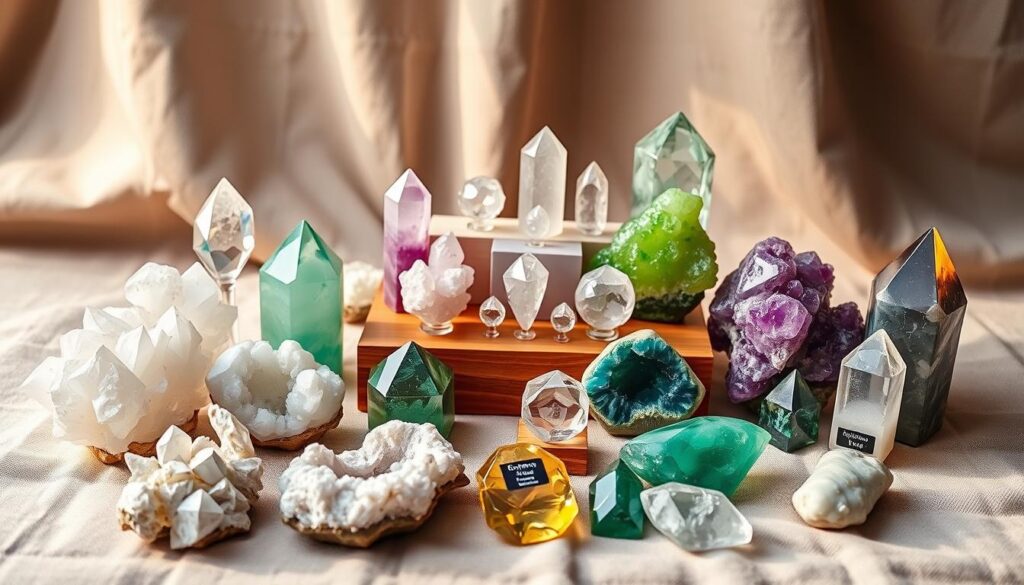
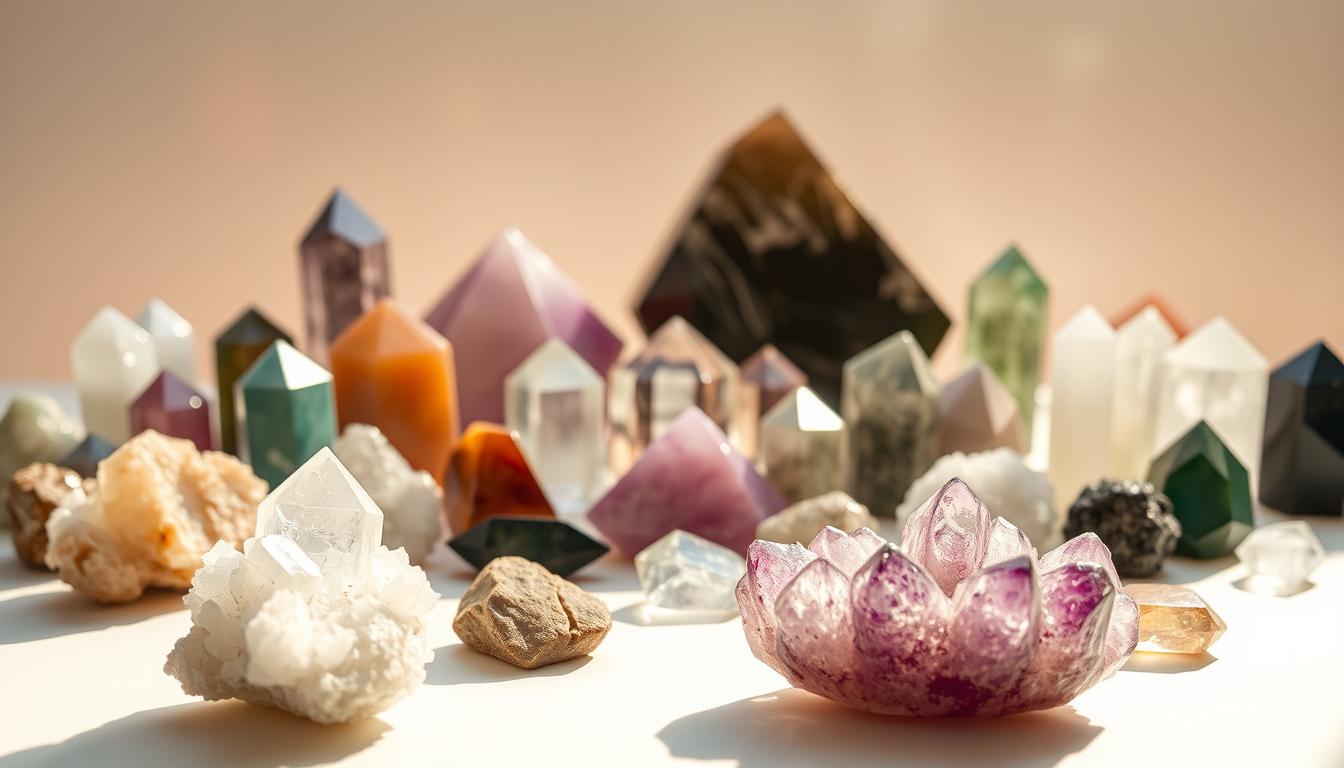
Common Crystal Shapes Collectors Find fascinate people worldwide, not just for their beauty but also for their unique properties and meanings. Each shape tells a story of millions of years of geological processes and carries its own special energy that collectors treasure.
The world of crystal collecting offers endless variety in shapes, from simple cubes to complex needle formations. Understanding these different forms helps collectors make better choices and appreciate the natural forces that created these stunning specimens.
TL;DR
- Crystals form in 7 main crystallographic systems that determine their basic shapes and properties.
- Perfect cubic pyrite specimens can sell for $50-500 depending on size and formation quality.
- Prismatic quartz crystals grow at temperatures between 573°C and 870°C in specific pressure conditions.
- Acicular rutile needles inside quartz create some of the most sought-after collector specimens worldwide.
Common Crystal Shapes Collectors Find
Crystal shapes form through precise geological conditions that take thousands to millions of years to develop. Temperature, pressure, and mineral composition work together to create the stunning variety we see in collections today.
The seven crystallographic systems – cubic, tetragonal, orthorhombic, hexagonal, trigonal, monoclinic, and triclinic – provide the framework for all crystal formations. Each system produces characteristic shapes that experienced collectors can identify at a glance.
Cubic and Octahedral Formations
Cubic crystals display perfect 90-degree angles and equal sides, making them some of the most recognizable formations. These shapes form in the isometric crystal system where all three axes are equal in length.
Pyrite: The Perfect Cube
Pyrite creates some of nature’s most perfect cubic crystals with mirror-like faces that reflect light brilliantly. These brassy gold specimens often form in sedimentary rocks and hydrothermal veins where iron-rich solutions crystallize slowly.
Spanish pyrite from Navajun produces the world’s finest cubic specimens, with some reaching several inches across. These formations command premium prices among collectors due to their geometric perfection and metallic luster.
Fluorite’s Octahedral Beauty
Fluorite commonly forms octahedral crystals that look like two pyramids stuck together at their bases. These eight-faced gems come in purple, green, blue, and clear varieties that collectors prize for their transparency and color intensity.
The famous Illinois fluorite deposits produced massive octahedral specimens before mining ceased in the 1990s. Today, Chinese and Mexican sources provide most octahedral fluorite for collectors worldwide.
Prismatic and Columnar Crystals
Prismatic crystals grow longer in one direction than the other two, creating elongated formations that catch and refract light beautifully. These shapes develop when crystal growth favors one axis over others during formation.
Quartz: The Ultimate Prismatic Crystal
Quartz forms classic six-sided prismatic crystals terminated by pointed pyramids at one or both ends. Clear quartz, amethyst, citrine, and smoky quartz all follow this basic pattern while displaying different colors and clarity levels.
Arkansas produces some of the world’s finest clear quartz points, with specimens reaching several feet in length. Brazilian amethyst geodes contain thousands of prismatic crystals growing inward from cavity walls.
Beryl’s Hexagonal Columns
Beryl creates impressive hexagonal columnar crystals that include emerald, aquamarine, and morganite varieties. These specimens can grow enormous – some beryl crystals from pegmatites measure over 10 feet long and weigh several tons.
The color variations in beryl come from trace elements: chromium creates emerald green, iron produces aquamarine blue, and manganese gives morganite its pink hue. Each variety maintains the same hexagonal crystal structure.
Identification Tip
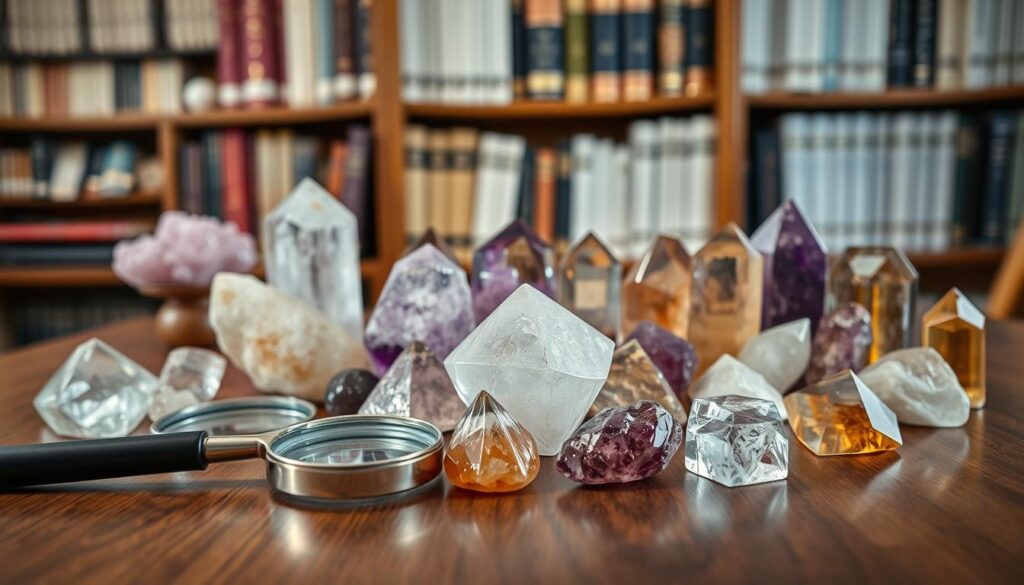
Use a magnifying glass to examine crystal faces and angles when identifying shapes. Natural crystals show slight imperfections while synthetic ones appear too perfect.
Tabular and Platy Formations
Tabular crystals grow much wider and longer than they are thick, creating flat, plate-like formations. These shapes result when crystal growth strongly favors two axes while restricting growth in the third direction.
Mica’s Perfect Cleavage
Mica minerals split into incredibly thin sheets due to their layered crystal structure. Muscovite and biotite mica can be peeled into sheets thinner than paper while maintaining their crystalline properties.
Large mica books from pegmatites sometimes measure several feet across and contain hundreds of individual sheets. These specimens demonstrate how crystal structure directly influences physical properties.
Selenite’s Transparent Plates
Selenite, a variety of gypsum, forms large tabular crystals with perfect transparency and silky luster. These formations develop in sedimentary environments where calcium sulfate crystallizes from evaporating water.
The Cave of Crystals in Mexico contains selenite beams over 30 feet long and several feet thick. These massive formations grew in superhot water over hundreds of thousands of years.
Acicular and Needle-like Crystals
Acicular crystals form extremely thin, needle-like shapes that often grow in radiating clusters. These delicate formations require very specific chemical conditions and slow crystallization rates.
Rutile’s Golden Needles
Rutile creates hair-thin golden needles that often grow inside quartz crystals, creating stunning inclusion specimens. These needle formations result from titanium dioxide crystallizing under high temperature and pressure conditions.
Rutilated quartz from Brazil contains some of the finest needle inclusions, with dense networks of golden threads creating mesmerizing patterns. These specimens command high prices due to their beauty and rarity.
Tourmaline’s Elongated Crystals
Tourmaline forms long, slender crystals with triangular cross-sections and distinct vertical striations. These crystals can display multiple colors in zones, creating watermelon tourmaline and other bi-color varieties.
Maine tourmaline deposits produce exceptional specimen-quality crystals in pink, green, and blue varieties. Some crystals reach over a foot in length while maintaining perfect terminations.
Identifying Crystal Shapes in Your Collection
Proper identification requires understanding the relationship between crystal structure and external form. Many crystals show modified habits where basic shapes combine or distort due to growth conditions.
Start by examining the crystal’s symmetry and measuring angles between faces. Use a protractor or goniometer for precise measurements, and compare your observations with standard crystallographic references.
Tools for Shape Analysis
- Magnifying glass – reveals surface details and face quality
- Protractor – measures angles between crystal faces
- Calipers – determines precise dimensions and proportions
- Reference books – provide comparison images and data
Natural vs. Polished Specimens
Natural crystals show original growth features like growth lines, etch marks, and natural terminations. Polished specimens lose these characteristics but may reveal internal structures and inclusions more clearly.
Look for tool marks, uniform surfaces, and artificial angles that indicate human modification. Natural crystals often show slight imperfections and variations that machine polishing removes. Learning to distinguish natural from artificial specimens is crucial for collectors building authentic collections.
Building a Shape-Focused Collection
Collectors focusing on crystal shapes often organize their specimens by crystallographic system or formation type. This approach helps develop pattern recognition skills and deeper appreciation for geological processes.
When starting a collection, consider specializing in one shape type to build expertise, then expand to related forms. For example, start with simple cubic crystals before moving to more complex octahedral and dodecahedral formations.
Storage and Display Considerations
- Fragile needles – store in individual boxes with padding
- Flat plates – stack carefully with tissue paper between specimens
- Points and clusters – display upright with secure bases
- Cubic crystals – can be stored together but avoid contact between specimens
For comprehensive protection guidance, proper storage techniques will prevent damage to your shaped specimens and preserve their value over time.
Frequently Asked Questions
What determines a crystal’s shape?
Crystal shape depends on internal atomic structure, formation temperature, pressure conditions, and available space during growth.
Are perfect crystal shapes more valuable?
Yes, well-formed crystals with complete faces and sharp edges typically command higher prices than damaged or incomplete specimens.
How can I tell if a crystal shape is natural?
Natural crystals show growth patterns, slight imperfections, and natural terminations, while artificial ones appear too uniform and perfect.
Which crystal shapes are rarest?
Complex forms like twinned crystals, skeletal growths, and unusual habits are generally rarer than simple geometric shapes.
Do crystal shapes affect metaphysical properties?
Many collectors believe different shapes channel energy differently, though scientific evidence for these claims remains limited.
Final Thoughts
Common Crystal Shapes Collectors Find represent millions of years of Earth’s geological history captured in beautiful geometric forms. Each shape tells a unique story of the conditions that created it and offers collectors insight into natural processes.
Start identifying shapes in your collection today using the guidelines above, and watch your appreciation for these natural wonders grow with every specimen you examine. Whether you’re a beginner collector just starting out or an experienced enthusiast, understanding crystal shapes enhances both the scientific and aesthetic appreciation of these remarkable natural formations.