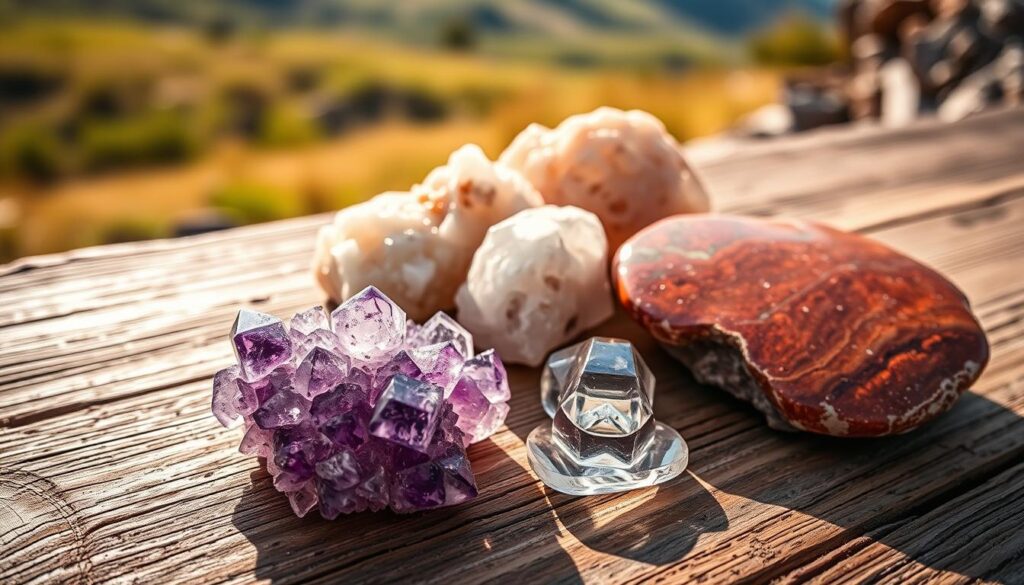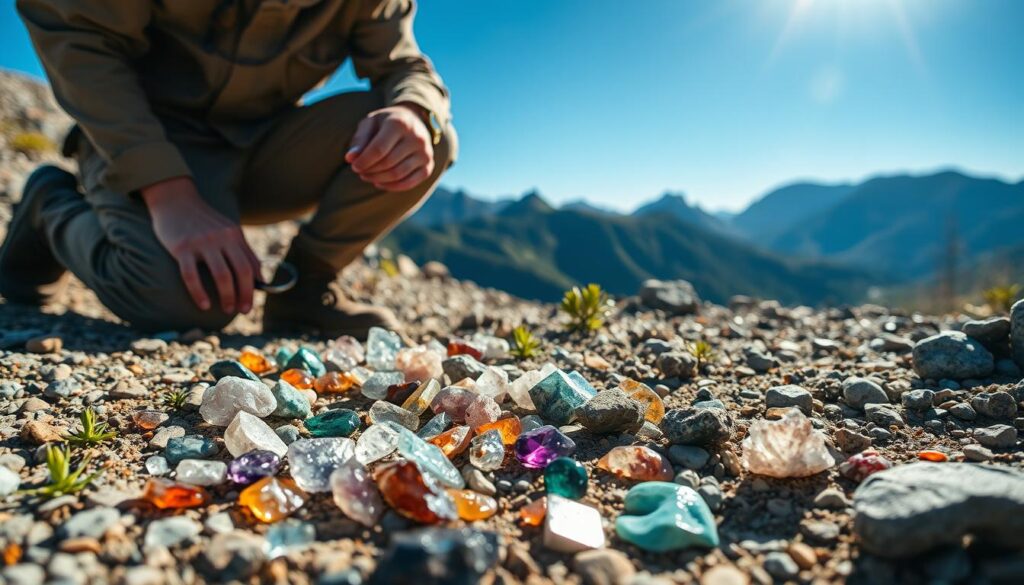
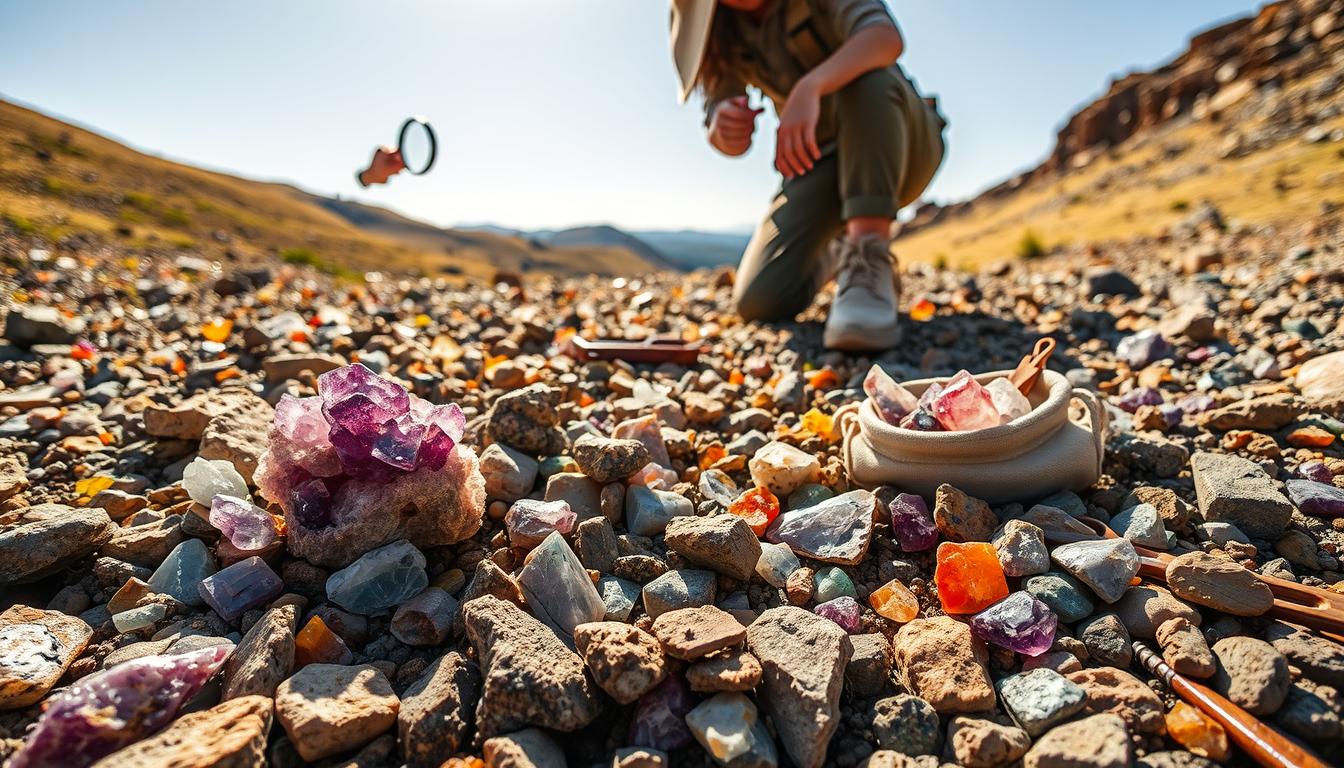
Minerals Commonly Found While Rockhounding offer endless discovery opportunities for both beginners and experienced collectors. Whether you’re exploring local creek beds or visiting dedicated rock shops, understanding what to look for can transform a simple walk into an exciting treasure hunt.
Most rockhounds start their collections with common specimens before moving on to rarer finds. The thrill comes from identifying each specimen and learning about the geological processes that created these natural wonders over millions of years.
TL;DR
- Quartz appears in over 12 different varieties including amethyst, citrine, and smoky quartz, making it the most abundant mineral for rockhounds.
- Feldspar makes up 60% of the Earth’s crust and shows up in pink, white, and green colors at most rockhounding locations.
- Pyrite contains up to 47% iron and creates perfect cubic crystals that fool beginners into thinking they’ve found gold.
- Calcite fizzes when touched with vinegar due to its calcium carbonate composition, providing an instant field identification test.
Minerals Commonly Found While Rockhounding
The world beneath our feet contains an amazing variety of minerals waiting to be discovered. Most rockhounding locations yield similar types of specimens, making it easier to build identification skills and start a meaningful collection.
Understanding the basic properties of common minerals helps you spot valuable specimens in the field. Each mineral has unique characteristics like hardness, color, crystal structure, and how it breaks that serve as identification clues.
Quartz Varieties Every Rockhound Encounters
Quartz stands as the most common mineral you’ll find during rockhounding adventures. This silicon dioxide mineral appears in countless forms, each with distinct colors and properties that make collecting endlessly interesting.
Clear and Colored Quartz Types
- Clear Quartz – completely transparent crystals that form perfect six-sided points.
- Amethyst – purple variety caused by iron impurities and natural radiation exposure.
- Citrine – yellow to orange crystals that often form in the same locations as amethyst.
- Smoky Quartz – brown to black variety created by aluminum impurities and natural radiation.
- Rose Quartz – pink variety that rarely forms well-defined crystals but appears in massive chunks.
Quartz rates a 7 on the hardness scale, meaning it scratches glass easily. You can identify quartz by its glassy luster and the way it breaks with smooth, curved surfaces rather than flat planes.
Feldspar: The Foundation Rock Mineral
Feldspar appears in nearly every rockhounding location because it makes up the majority of igneous rocks. This aluminum silicate mineral comes in two main varieties that show different colors and crystal habits.
Potassium feldspar typically shows pink, salmon, or white colors with a blocky crystal shape. Plagioclase feldspar ranges from white to dark gray and often displays thin parallel lines called twinning striations across crystal faces.
Identifying Feldspar in the Field
- Hardness – rates 6 on the hardness scale, slightly softer than quartz.
- Cleavage – breaks along two planes that meet at 90-degree angles.
- Luster – shows a glassy to pearly shine on fresh surfaces.
- Crystal habit – forms rectangular or square-shaped crystals.
Pyrite: Fool’s Gold That Teaches Identification Skills
Pyrite earned the nickname “fool’s gold” because its brassy yellow color tricks inexperienced prospectors. This iron sulfide mineral actually provides excellent practice for developing identification skills and understanding mineral properties.
Real gold stays bright yellow in all lighting conditions and feels much heavier than pyrite. Pyrite often forms perfect cubic crystals with striated faces, while gold appears in irregular nuggets or flakes.
Quick Pyrite vs Gold Test
Scratch the specimen with a steel nail. Pyrite creates dark gray to black streaks, while gold leaves a golden yellow streak.
Calcite and Its Fizzing Reaction
Calcite provides one of the most satisfying field identification experiences when you apply the acid test. This calcium carbonate mineral fizzes vigorously when exposed to weak acids like vinegar or lemon juice.
You’ll find calcite in many different colors including clear, white, pink, blue, and honey yellow. The mineral often forms dog-tooth shaped crystals or appears as massive crystalline chunks in limestone and marble areas.
Calcite Identification Features
- Hardness – rates only 3 on the hardness scale, easily scratched by a copper penny.
- Cleavage – breaks into perfect diamond-shaped pieces along three directions.
- Double refraction – clear specimens make text appear doubled when viewed through the crystal.
- Acid test – fizzes immediately when touched with vinegar.
Mica: The Mineral That Splits Into Sheets
Mica minerals split into paper-thin sheets that remain flexible and transparent. This unique property makes mica impossible to confuse with other minerals once you’ve seen it in action.
Muscovite mica appears clear to light brown and was once used as window glass in colonial America. Biotite mica shows dark brown to black colors and contains more iron and magnesium than its lighter cousin.
Hematite: Iron Ore That Leaves Red Streaks
Hematite serves as the primary ore of iron and leaves a distinctive red-brown streak when scratched across unglazed ceramic. This iron oxide mineral appears in metallic silver, dull red, or earthy brown colors depending on its crystal structure.
Specular hematite displays bright metallic luster and forms plate-like crystals that reflect light like mirrors. Kidney ore hematite appears as rounded, bulbous masses with a dull red-brown surface.
Magnetite: The Natural Magnet
Magnetite draws iron objects like nails and paperclips, making it one of the easiest minerals to identify in the field. This iron oxide mineral appears black with a metallic luster and feels surprisingly heavy for its size.
Some magnetite specimens show strong enough magnetism to pick up iron filings or deflect compass needles. The mineral often forms octahedral crystals that look like two pyramids stuck together base-to-base.
Garnet: The Gemstone in Common Rocks
Garnet appears as small red crystals embedded in metamorphic rocks like schist and gneiss. These silicate minerals form distinctive twelve-sided crystals called dodecahedrons that resist weathering better than surrounding rock.
Most garnets you’ll find while rockhounding show deep red colors, though the mineral family includes orange, yellow, and green varieties. Garnet rates 6.5 to 7.5 on the hardness scale and shows a glassy luster when fresh.
Frequently Asked Questions
What tools do I need to identify minerals while rockhounding?
A hardness testing kit, hand lens, streak plate, small magnet, and dilute acid for testing calcite cover most identification needs. Essential equipment is covered in our guide to tools every mineral collector should own, while our field identification guide provides detailed testing methods.
How can I tell if a mineral specimen is valuable?
Look for well-formed crystals, unusual colors, large size, and rarity in your area. Most common minerals have modest value, but perfect specimens of any mineral can be worth collecting.
Where are the best places to find these common minerals?
Road cuts, creek beds, quarries, and mine dumps offer excellent collecting opportunities. Our guide on where to find minerals in nature provides specific location tips. Always get permission before collecting on private property and check local regulations.
How do I clean and preserve mineral specimens?
Use soft brushes and water for most cleaning, avoiding acids except for calcite removal. Learn proper techniques with our comprehensive guide on how to clean minerals without damaging them, and discover proper storage methods in our article about storing and displaying mineral specimens.
What’s the difference between rocks and minerals?
Minerals are pure chemical compounds with specific crystal structures, while rocks contain mixtures of different minerals. A granite rock contains quartz, feldspar, and mica minerals.
Final Thoughts
Minerals Commonly Found While Rockhounding provide the foundation for understanding Earth’s geological processes and building a meaningful collection. Start with these common specimens to develop identification skills before pursuing rarer finds.
Each rockhounding trip offers chances to discover new specimens and improve your mineral knowledge. Keep detailed records of where and when you find each specimen to build a valuable reference collection over time.